Groove Theory

Groove Theory finds the less-known part of how something got made, and hands it over for your own work.
Sometimes that's someone you've never heard of, like Bill Pankow, who edited Carlito's Way for Brian De Palma. Sometimes it's the part of a famous act nobody looks at: Penn & Teller doing the oldest trick in magic with see-through cups, and you still can't see how. Either way, you should finish with something you could try at work on Monday.
Every edition is in the archive, free, no signup needed.
The Five Elements
Each edition focuses on one of five elements - patterns I noticed across hundreds of sessions with founders, leaders, and creative teams. Together, they form a vocabulary for creative work that resonates.
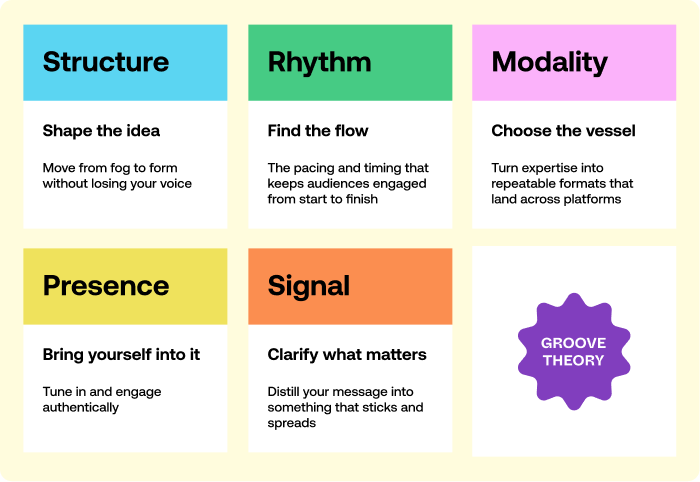
Structure - Shape the idea
How do I give my ideas form without losing their soul?
Move from fog to form without losing your voice. Turn scattered thinking into something usable and repeatable - the difference between rambling for 20 minutes and making your point in 2.
Featured: The Beautiful Map Nobody Wanted - Why a perfect strategy for reimagining NYC transport failed, and what it teaches about giving ideas form.
 Howard Gray
Rhythm - Find the flow
How do I pace my work and navigate creative tension?
The pacing and timing that keeps audiences engaged from start to finish. When you find your flow, you know when to push and when to pause.
Featured: The One Person Orchestra - How Tash Sultana builds entire concerts alone.
Howard GrayModality - Choose the vessel
What format best serves this idea?
Turn expertise into repeatable formats that work across platforms. Sometimes an idea wants to be a workshop. Sometimes a keynote. Sometimes a conversation. Choosing the right format is how you make work resonate.
Featured: The Little Green Arrow - How Citymapper succeeded as a guide but failed when it tried to become an operator.
Howard GrayPresence - Bring yourself into it
How do I show up authentically and read the room?
Responding to what's happening in the room, rather than delivering the version you rehearsed.
Featured: Nothing Business - Marina Abramovic's most remarkable installation came about from... nothing
Howard Gray
Signal - Clarify what matters
How do I distill my message so it sticks and spreads?
The core idea people remember and repeat. In a world of infinite content, clear signal is how you cut through the noise.
Featured: When your song becomes someone else's - what Trent Reznor learned when he gave away his most personal work
Howard GrayWho It's For
Groove Theory is for people doing a job nobody gave them a playbook for. Maybe you advise people and want your ideas to hang together. Maybe you've been handed something new and you're working it out as you go.
Each edition names two or three things the person did, and carries one of them over to your side of the desk. Take what fits.
The Backroom
Groove Theory isn't trying to be the biggest newsletter in your inbox. It's the backroom - its own crowd, its own energy, its own regulars who come specifically for this. Some people never go to the main room at all.
I started it because I kept finding these stories and noticing patterns nobody was talking about. The newsletter became a way to collect them.
In the room are around 1,300 readers, and more than four in ten open every edition. Every other Sunday.
Or start anywhere in the archive.
Want everything I write, not just the fortnightly? See both options - it is a lot more email, and that page says so.